
WHY ACTIVE ALIGNERS
Why Active Aligners Have Low Refinement Rates
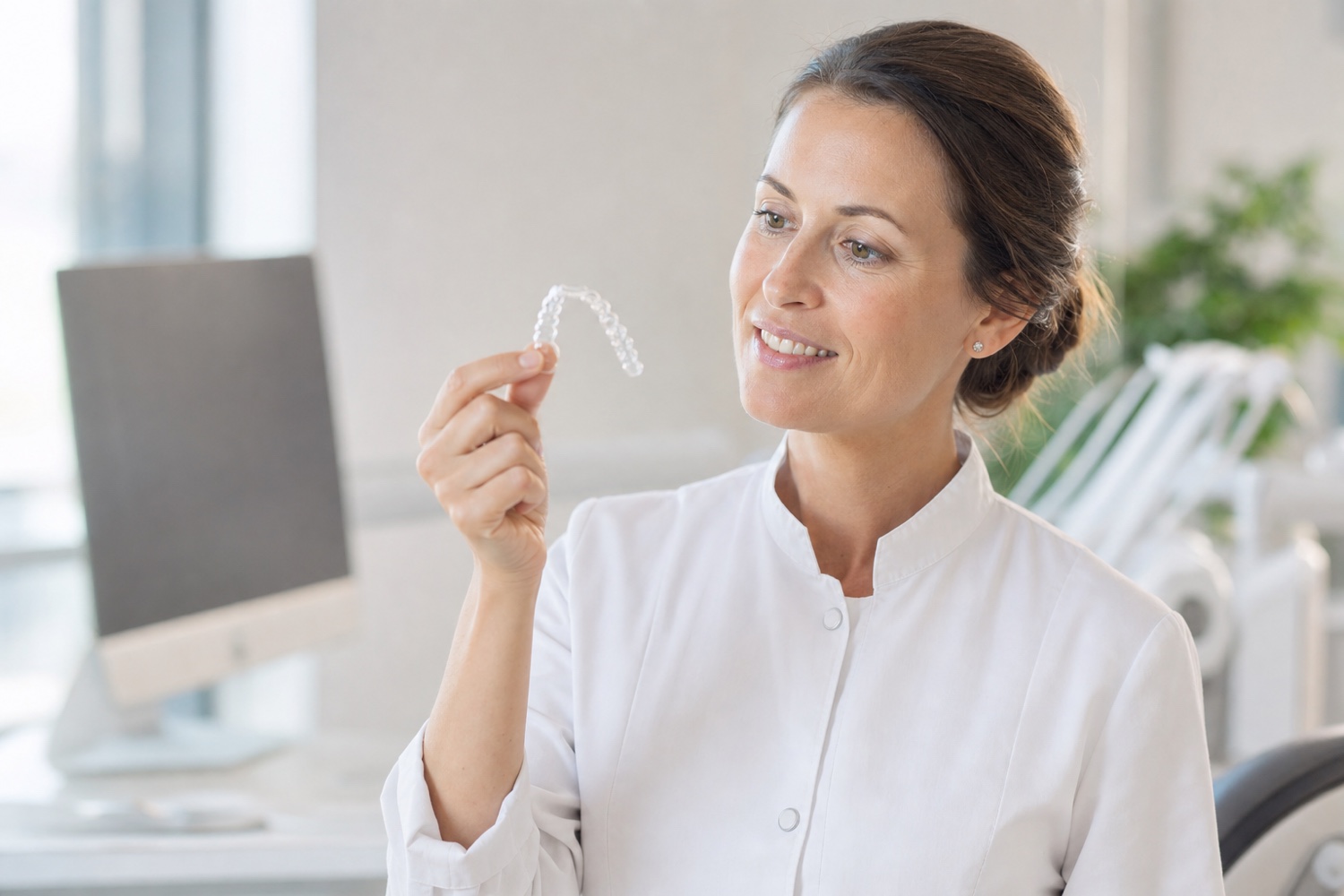
Refinements shouldn’t be the norm, they should be the exception. Our refinement rate is 25 to 35%. That’s from our own case records, which we check every month. Here’s why our approach works, and how to maximise first-time treatment success.
THE CORE PRINCIPLE
A refinement should be the exception, not the plan
Published research on clear aligner treatment shows how often refinements happen. In one study of 500 patients, only 6% finished without a single refinement scan, and the average patient needed 2.5 of them (Kravitz et al., AJODO 2023). Another study found that 72.2% of patients needed at least one extra treatment plan and a new set of aligners (Meade et al., The Angle Orthodontist).
Our rate of 25 to 35% isn’t luck. It’s the outcome of how a case is planned, reviewed and supported from the very first scan.
25 to 35%
Our refinement rate
Only 6%
Of 500 patients in a published study finished without a single refinement scan (Kravitz et al., 2023)
Every case
Dentist reviewed and approved before manufacture

THE REALITY OF REFINEMENTS
Where high refinement rates come from
When a case needs extra aligners, it’s usually down to overpromising tooth movement, aggressive timelines, inadequate planning, poor compliance management and a lack of provider support.
There’s a bigger reason underneath all of that. Trays don’t deliver every movement the plan asks for. One study measured how much of the planned movement actually happened and put it at 41% (Kravitz et al., AJODO 2009). A follow-up by the same group found it had improved since, though it still falls short of the plan. Plan past what a tray can really do and you’ve built a refinement into the case.
Our rate is the result of a different way of working:
- Research- and results-driven protocols
- Dentist review and approval before manufacture
- Realistic movement protocols
- Clear wear and compliance guidance for every patient
- Provider support once you become a provider
- Support when a case needs a mid-treatment decision

SEVEN REASONS OUR RATE IS LOWER
What we do differently, step by step
- Research- and results-driven movement protocols, movements are staged around what aligners can predictably achieve, with attachments where they help force expression, IPR planned to create space at the right stage, so the treating dentist can catch issues early at review. Plans are grounded in real-world aligner behaviour, not just digital simulations.
- Dentist review and clinical responsibility, cases are prepared by our team and returned to the provider, who reviews, requests any modifications and approves before manufacture. The treating dentist or orthodontist monitors the patient through treatment and retains full clinical responsibility for their care.
- Proper IPR and attachment protocols, IPR at the correct stages in conservative amounts (max 0.5mm per surface); attachments placed only where biomechanically necessary, designed for proper force vectors, and template-guided.
- Staged movement approach, sequential movement (align, level, then detail), proper staging of difficult movements, adequate stages per millimetre, and rest stages where needed.
- Digital precision, intra-oral scanning is more accurate than impressions (no distortion or shipping damage), and what you approve in the 3D viewer is what we manufacture.
- Provider education and support, WhatsApp support, weekly webinars, treatment-plan review support, and guidance on when to intervene versus wait, so small tracking issues are caught early.
- Honest case selection, we’ll tell you when a case is better suited to traditional orthodontics. Better to decline a case than deliver a mediocre result.
THE CLINICAL DRIVERS
Three design choices that keep refinements low
The process reasons above are half the story. The other half is clinical. Three design and planning choices do a lot of the work of getting a case right the first time.
DRIVER ONE, THE TRIMLINE
A 2mm extended trimline
Most aligners are cut in a wavy, scalloped line that follows the gum. Active Aligners are trimmed straight and extended 2mm past the gum line. That extra coverage grips more tooth surface, which means better retention, better force expression and more moment on every planned movement.
Independent in-vitro research on gingival margin design supports the principle that a straighter, extended trimline improves aligner retention compared with a scalloped margin (Cowley et al.). Trimline design is a property of the appliance, not an Active Aligners treatment outcome claim.
Driver two, arch expansion first
Where possible we expand the arch before moving teeth. Creating space up front lets every planned movement track more predictably.
Driver three, right sized attachments
Attachments act as force drivers. We place them where they matter and size them to the movement, controlling rotations and stubborn teeth while assisting simpler movements.
HONEST CASE SELECTION
Complexity is not a barrier, dentist-led planning is the point
Active Aligners handles a wide range of cases, from simple alignment to genuinely complex movements, always dentist led. Complexity is not a barrier, our planners build for it. Choosing a straightforward case for your first few builds your confidence, and as you progress the same protocols carry you into more complex work.
Straightforward first cases
- Crowding up to around 6mm per arch
- Minor rotations
- Relapse cases
- Spacing closure
- Minor bite corrections
More complex, and we plan for it
- Heavier crowding, larger rotations and vertical changes, our planners build for these
- A more complex case does bring a higher chance of a refinement, though many still finish first time
- Only rare exceptions are better referred to a specialist, such as a deeply palatally impacted tooth or a high eye tooth
- Those are positions where an aligner cannot wrap around the tooth well enough to grip and move it
HOW YOU CAN MINIMISE REFINEMENTS
Your role in first-time success
During planning
- Be specific in your treatment goals
- Communicate patient priorities
- Review the plan stage by stage before approval
- Request modifications if anything seems aggressive
During treatment
- Emphasise compliance (22 hours/day)
- Check tracking at 8 to 10 week intervals
- Contact us immediately if aligners aren’t seating
- Don’t let patients advance stages if tracking is off
- Use chewies consistently
Patient selection
- Choose compliant patients for your first cases
- Take on your most complex cases once you have a few under your belt
- Set realistic expectations about duration
- Screen for habits that impact compliance
WHEN REFINEMENTS ARE ACTUALLY NEEDED
Refinements aren’t failures
Sometimes they’re planned. Legitimate reasons include patient compliance issues, biological variation (some teeth move slower), mid-course goal changes, or an initial conservative approach with a planned phase 2.
HOW WE HANDLE THEM
Right, not rushed
When one is needed, we provide free refinement scans, a quick turnaround, analysis of why it was needed, and an adjusted approach. Lower refinements mean happier patients and a more profitable practice, and we’d rather take longer to plan it right than rush to manufacturing.
Plan it right, refine it rarely
See how our clinical approach, movement protocols and provider support come together, or open the Doctor’s Library for the detail behind every case.