
HOW THEY ARE MADE
How clear aligners are made
Every Active Aligner begins as a digital scan of your teeth and ends as a precise, medical-grade tray formed under positive pressure. Here is the full journey, from scan to plan to printed models to thermoforming, trim and quality control, and why each step matters for the result in your mouth.
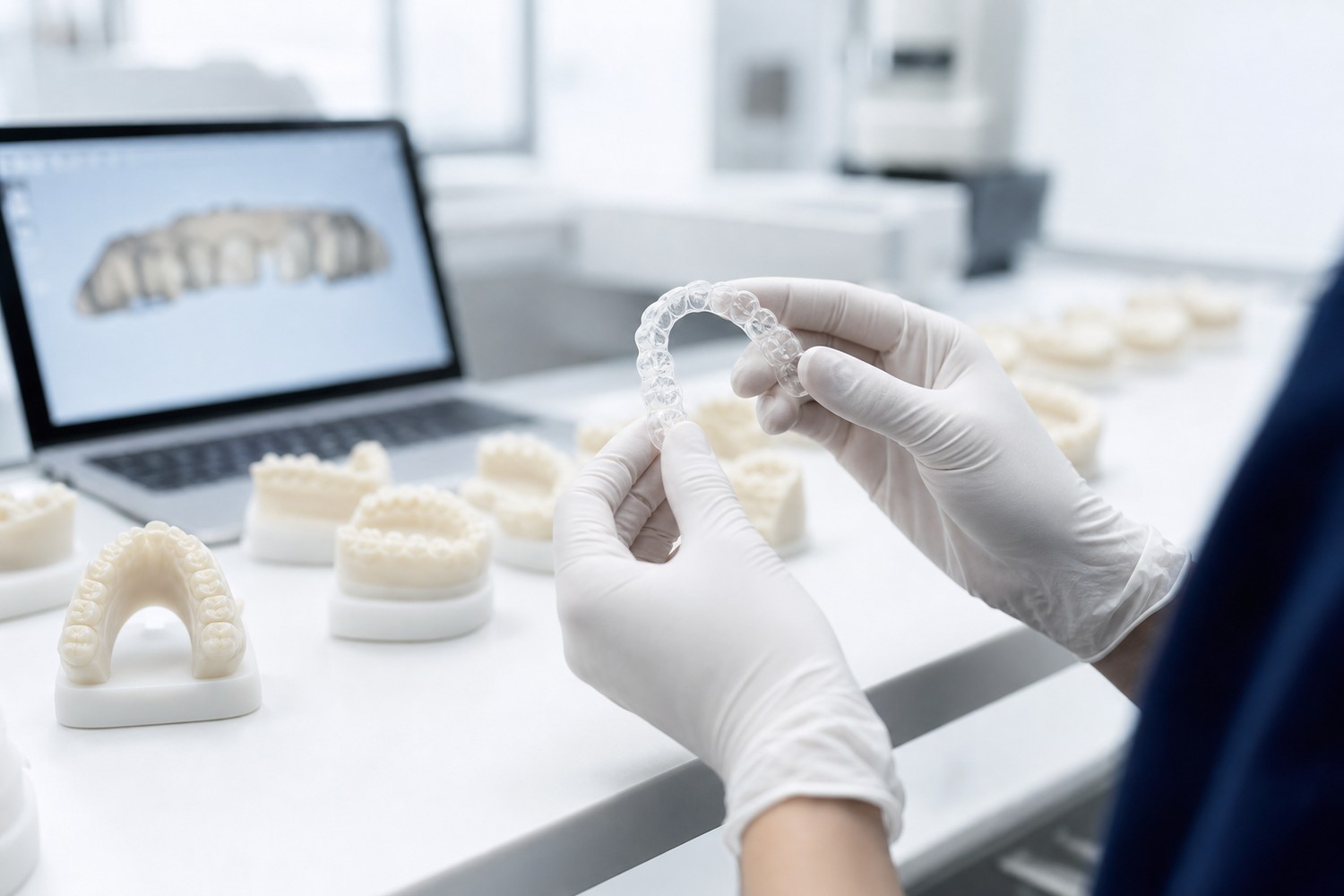
What a clear aligner actually is
Prescribed by your dental professional, Active Aligners are clear aligners developed specifically to move your teeth in a predictable, smooth and comfortable way. Instead of metal brackets, wires or screws, you wear a series of medical-grade thermoplastic trays that gently guide your teeth toward the planned result, while going largely unnoticed by the people around you.
Each tray is custom made for your teeth at one stage of treatment. The precision behind that tray, the material it is formed from, the way its edge is trimmed and the pressure used to form it, is what separates an aligner that simply fits from one that actually moves teeth as planned.
From scan to finished aligner
Six stages take your case from the chair to a tray in your hand. The clinical steps happen with your provider. The laboratory steps happen at the bench.
STEP 01
Scan and records
Your provider checks your oral health, then captures a digital scan or physical impression of your teeth, along with quality control images and x-rays where needed.
STEP 02
Treatment plan
Your records become a 3D model of your bite. A virtual setup maps every stage of movement, so your provider can see the end result before you start.
STEP 03
Printed stage models
A physical model is 3D printed for each stage of treatment. These printed models are the moulds the aligners are formed over, not the aligners themselves.
STEP 04
Positive-pressure forming
Medical-grade tri-layer material is heated and formed over each stage model under positive pressure, capturing fine detail at the tooth and the gumline.
STEP 05
Trim and finish
Each tray is cut to a precise 2 mm extended straight trimline and the edges are finished so the aligner is comfortable against the gums and grips the tooth.
STEP 06
Quality control
Before delivery to your provider, every set is checked for margins, borders, thickness, numbering and arch form, so each stage fits and works as planned.
Scan, plan and a virtual setup
A 3D scan or impression captures a precise replica of your teeth. From that, a digital model is built and a smile summary is created. A virtual setup then walks your dental professional through the planned treatment, stage by stage, all the way to the final result.
This is one of the real advantages of aligner therapy over traditional orthodontics. Your provider sees and approves the intended outcome before treatment begins, and every aligner in the series is made to deliver that plan.
3D printed stage models
For each stage of your treatment, a physical model of your teeth is 3D printed. These models represent your teeth at that exact point in the journey, a little straighter at every stage.
It is worth being precise about what is printed and what is not. The 3D printers produce the stage models. The aligner itself is not 3D printed. It is formed over each printed model in the next step. Our printers are calibrated to our own laboratory conditions rather than off-the-shelf defaults, so the models stay accurate stage after stage, which is what keeps the finished trays accurate too.
Thermoforming, where the aligner is born
Thermoforming is the stage where the printed stage model meets the medical-grade material that becomes your aligner. The material is heated until pliable, then formed tightly over the model. The aligner is thermoformed, not 3D printed, and the difference is the whole point of this page.
Every Active Aligner is formed using positive-pressure thermoforming rather than simple vacuum suck-down. Forming the material under positive pressure presses it into fine detail at the tooth surface, the gumline and the gingival margin, so each tray fits precisely and transfers force exactly as the plan intends. Accuracy at the bench is what makes treatment predictable in the mouth.
The tri-layer material
Active Aligners are formed from a medical-grade, tri-layer shape-memory material. Firm, clear outer layers are bonded to a soft, springy core. The outer layers hold their shape and express precise, controlled force. The inner layer flexes to deliver that force gently, so the push on your teeth is longer and more continuous across each stage of wear.
The practical result is an aligner that is comfortable, stays clear and virtually invisible, and is engineered to actually move teeth rather than simply sit over them.
The 2 mm extended trimline
How the aligner is trimmed matters as much as how it is formed. Active Aligners use a 2 mm extended straight trimline rather than a scalloped edge that follows the gumline. Extending the edge straight onto more tooth structure gives the tray more surface to grip, which supports better retention and a more reliable transfer of force to the teeth.
This is well supported in the wider literature. Independent in-vitro research on gingival margin design found that a straight trimline extended onto the tooth significantly improved aligner retention compared with a scalloped margin. You can read the study here. It is research on trimline design generally, not an Active Aligners outcome claim, and it is one of the reasons we trim the way we do.
Quality control before it reaches you
Before any aligner is delivered to your provider, a thorough quality check is carried out on every set. We check margins, borders, thicknesses, numbering and arch form across the full series, so the trays arrive sequenced correctly and each one fits as it should.
Every set is delivered to your provider with a comprehensive patient instruction manual. Worn as directed and changed on schedule, your aligners carry your teeth smoothly from one stage to the next.
Wearing your aligners
- Wear each aligner 20 to 22 hours a day.
- Move to the next set after 1 to 2 weeks, or as your provider instructs.
- Seat each aligner fully with the help of chewies.
- Insert and remove your aligners carefully, as shown by your provider.
- Clean your aligners regularly to maintain good oral hygiene.
Ready to start?
Find an Active Aligners provider near you and book a consultation.