
FOR PATIENTS
How clear aligners work
Active Aligners are an alternative to traditional braces and are known in the dental industry as clear aligner therapy. In clear aligner therapy, clear customised “aligners” are worn in sequence to move a patient’s teeth in stages until their optimal alignment has been reached. Think “invisible braces”.

Worn in stages
A sequence of clear trays moves teeth gradually
Dentist-led
Every plan is approved by your treating provider
Virtually invisible
Discreet, removable and comfortable to wear
WHAT THEY TREAT
What clear aligners can treat
Dental professionals use Active Aligners to treat a range of common bite and spacing concerns. The six examples below are the main patient-facing examples, not a diagnosis or a full clinical assessment. Your provider confirms whether your specific case is suitable during your consultation.
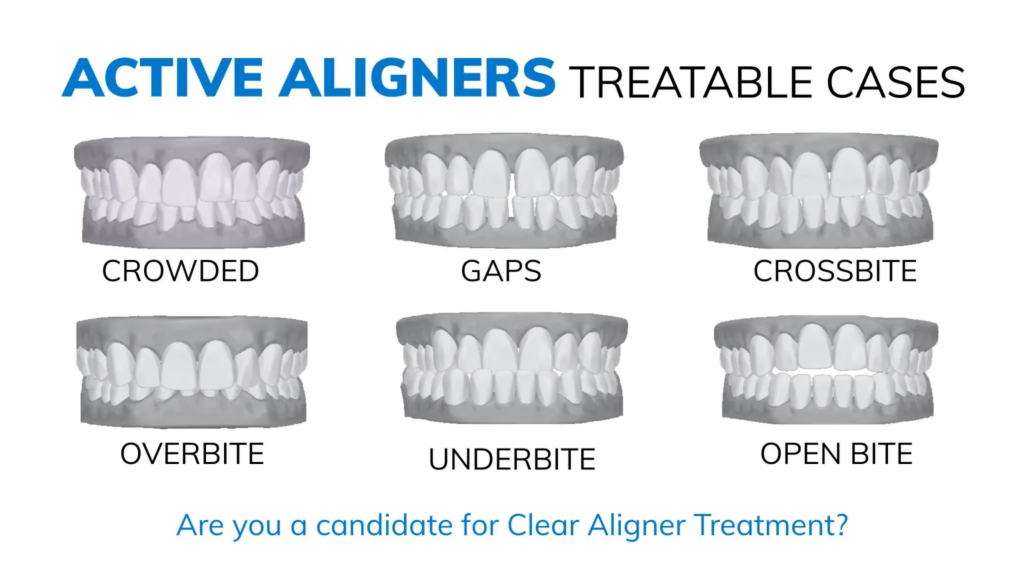
Crowding
When teeth overlap or compete for space.
Gaps
Spacing between teeth that can often be closed gradually.
Crossbite
When some upper teeth bite inside the lower teeth.
Overbite
When the upper teeth sit too far over the lower teeth.
Underbite
When the lower teeth sit forward of the upper teeth.
Open bite
When the front teeth do not meet fully when biting down.
WHO THEY ARE FOR
Who clear aligners are for
Active Aligners are for anyone looking for a discreet alternative to traditional orthodontic braces that produces similar outcomes, with shorter treatment times on average.
Active Aligners are available to adults and teenagers provided they have been determined as candidates by their treating dental professional. The minimum age is set to 16, as it is required that all of the patient’s permanent teeth have erupted. Currently there is no maximum age for Active Aligners, and many adults find the nature of the treatment suits their lifestyle.
If a potential patient is uncertain about their candidacy, we recommend they consult their chosen Active Aligner provider to have their candidacy determined.
TREATMENT TIME
How long does it take?
The average Active Aligner case takes anywhere between 6 to 8 months.* Depending on the complexity of the case, this could be shorter or longer. Once a potential patient has undergone their candidacy assessment by a registered dental professional, and it has been determined that they are a candidate, the details of the treatment, including the expected length of treatment, will be available to them.
*Average treatment time, varies with case complexity. Your provider confirms your expected timeline at your consultation.
VERSUS TRADITIONAL BRACES
Active Aligners and traditional orthodontics
Traditional orthodontics use metal wires and brackets bonded to the teeth to move them into their desired positions. Instead of wires or brackets, Active Aligners are clear, removable trays set to the position a patient’s teeth should reach after each stage. This applies a slight yet highly precise force to specific teeth over the treatment time as the aligners are worn, gradually moving them into their most optimal positions.
Active Aligners treat a wide range of cases, from simple crowding and spacing to genuinely complex movements, bites, rotations and previous orthodontic relapse. The only real exceptions are the rare cases where an aligner physically cannot engage a tooth, like a high, partially-erupted canine or a deeply impacted tooth, and for those few your dentist may suggest a specialist as the better path for that specific case. For most candidates Active Aligners are preferred, as they are virtually undetectable, removable, more comfortable, and in most cases have faster treatment times while producing similar results.
THE ACTIVE ALIGNER DIFFERENCE
Not all aligners are the same
Clear aligners may look alike, but the engineering behind them is not. Active Aligners pair a premium material with a precise manufacturing process so teeth track as planned and treatment stays predictable for your provider.
Tri-layer material
A medical-grade, tri-layer shape-memory material with firm, clear outer layers bonded to a soft, springy core. The outer layers hold their shape and express precise force, while the core flexes to deliver it gently, so the push on each tooth stays longer and more continuous across the stage.
2 mm extended trimline
A straight trimline that extends about 2 mm onto the tooth, rather than a scalloped edge, grips more tooth structure for stronger retention and more reliable force transfer, so the aligner seats fully and stays seated through the stage. Independent in-vitro research on trimline design points the same way.
Positive-pressure accuracy
Each aligner is thermoformed under positive pressure, not vacuum suck-down, pressing the material tightly against the model to capture fine detail at the tooth surface and the gum line, so it fits precisely and works exactly as the plan intends.
Always dentist-led
Active Aligners are only ever delivered through dental professionals. Your treating provider plans, approves and oversees your case at every stage, with our experienced treatment-planning team and strict quality standards behind them.
HOW THE PROCESS WORKS
It is as easy as consult, align, retain
An overview of the average Active Aligner treatment journey, from your first consultation to holding your new smile in place.
1
Consultation and candidacy
Your provider assesses the overall condition of your mouth and completes any necessary dental work first, for example fillings or restorations, to get your mouth ready for Active Aligners.
This is followed by a 3D scan or impression, which is sent to the treatment planners to determine candidacy. If you are a candidate, the team digitally plots every tooth movement and models your new smile according to your provider’s instructions.
2
Your aligner journey
On approval of the plan, your case is manufactured in under 2 weeks. The stage models are 3D printed to high accuracy, and each aligner is then thermoformed under positive pressure on those models.
If your plan needs IPR or attachments, your provider completes this first. You then wear each aligner about 22 hours a day and move to the next stage every 1 to 2 weeks, checking in with your provider every 8 to 10 weeks to monitor tracking.
3
Retention
Once treatment is finished, you wear your retainers for a minimum of 3 months to maintain your newly aligned smile.
After that, you can move to nightly wear or a fixed lingual retainer at the discretion of your treating professional. One set of retainers is included per treatment.
WHERE TO GO FROM HERE
Ready to explore your options?
Anyone interested to see how Active Aligners could benefit their smile is advised to book an appointment with an Active Aligner provider. During the first consultation, your provider determines whether Active Aligners are the recommended treatment for you, then explains the next steps and oversees your treatment to ensure you are pleased with your results.
Active Aligners are only available through Active Aligner providers. Should Active Aligners not be the right treatment for your specific needs, your provider may refer you to an orthodontist who can recommend an alternative suited to you.
Ready to start?
Find an Active Aligners provider near you and book a consultation.